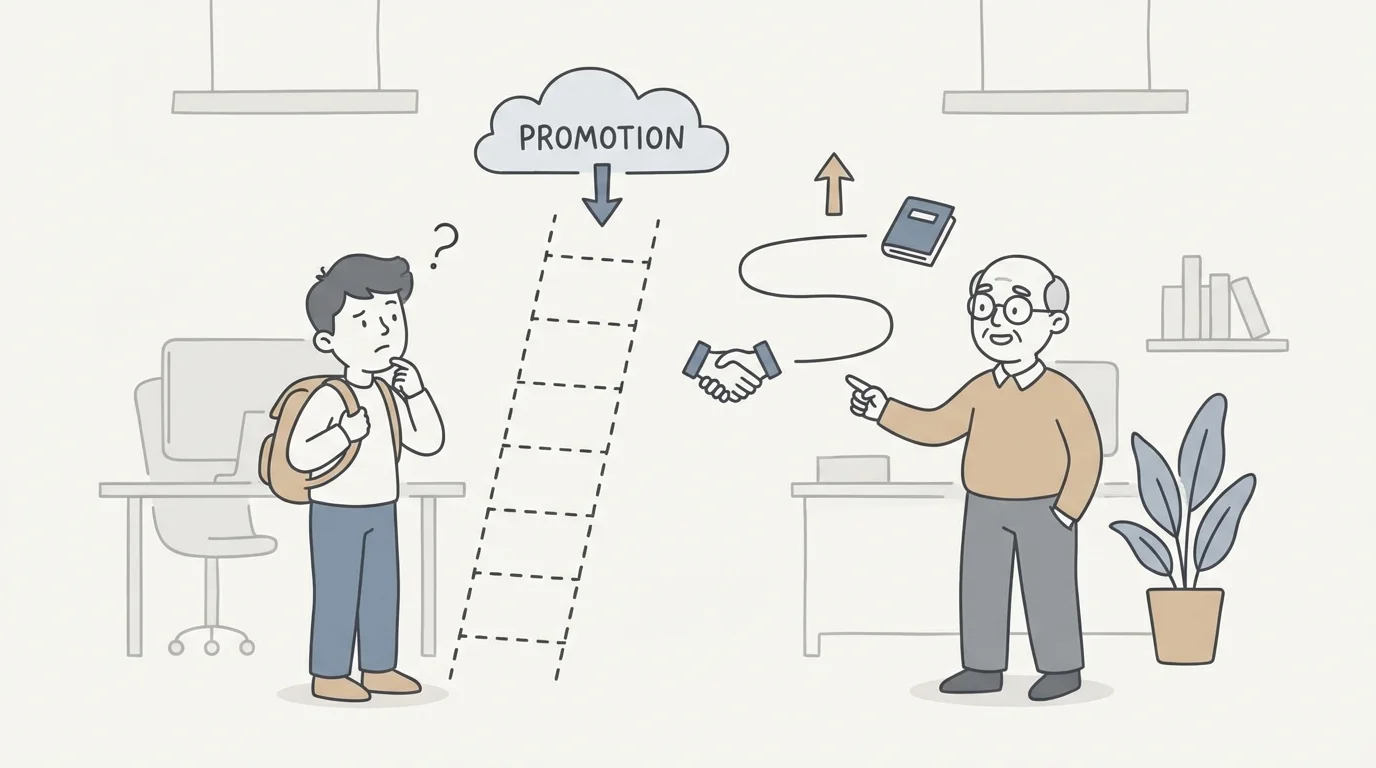
The New Grad Promotion Checklist: What You Need in Your First Two Years


 CareerClimb
Building your first case?
Track wins from day one and get AI coaching on exactly what your first promotion requires.

Share this article
The jump from junior to mid-level software engineer is the most predictable promotion in tech. The criteria are consistent across companies, the timeline is knowable, and the steps are concrete. Yet most new grads approach it without a plan, hoping that enough months of good work will eventually add up.
It does not work that way. Promotion committees and calibration meetings evaluate specific categories of evidence. If you have that evidence, your case moves forward. If you do not, your manager can advocate all they want and it will not be enough.
Here is the checklist. Not vague advice. Specific things you should have done, built, or documented before your manager puts your name forward.
Skills you need to demonstrate
These are the capabilities that separate junior from mid-level at nearly every company. You do not need to master all of them on day one. You need to show clear progression across all of them by month 18.
Technical autonomy. You can take a feature from design to production without your manager or a senior engineer making decisions for you. You write design docs when the problem is ambiguous. You break down large tasks into smaller ones and execute them in order. When something breaks, you debug it systematically instead of asking someone to look at it.
Code quality and consistency. Your pull requests rarely need major revisions. You follow your team's conventions without being reminded. You think about edge cases, error handling, and how your code will be maintained by someone else. Promotion committees often look at peer review feedback as a signal here.
System-level thinking. You understand how your service fits into the broader architecture. You consider performance, scalability, and failure modes, not just correctness. When you make a design choice, you can explain why you chose it over alternatives.
Communication. You write clear technical documents. You explain your work in design reviews without being prompted. You surface blockers and tradeoffs early instead of waiting until they become problems. If you are quiet in meetings, that is fine, but your written communication needs to be strong.
Relationships you need to build
Promotion is never a solo activity. Your case depends on what other people say about you when you are not in the room.
Your manager. By month 6, your manager should know your promotion goal and have given you specific criteria. You should be meeting regularly, discussing your progress against those criteria, and adjusting your work accordingly. If your 1:1s are status updates about tickets, you are wasting them. Learning how to make your manager fight for your promotion turns those 1:1s into real advocacy-building conversations.
A senior engineer who can vouch for you. This is someone who has worked with you closely enough to say: "Yes, they operate at mid-level. I have seen it." This does not need to be a formal mentorship. It can be a tech lead on a project you worked on, or a senior engineer who reviewed your design docs.
At least one person outside your team. Cross-team recognition strengthens your case in calibration. If you worked on a shared project, helped another team with an integration, or contributed to a company-wide initiative, the people on the other end of that work can speak to your impact. One outside perspective is worth more than ten more data points from your immediate team.
Documentation you need to maintain
Your memory is unreliable. So is your manager's. The engineers who get promoted on schedule are the ones who treated documentation as a weekly habit, not a last-minute scramble.
A weekly win log. Every Friday, write down what you shipped, what you unblocked, and what impact it had. Keep it short. Five to eight bullet points. After 12 months, this document contains 50+ data points that form the backbone of your self-review and your manager's promotion narrative.
A self-assessment against your company's rubric. Most companies have a career ladder or a set of level expectations. Read yours in your first month. Then, every quarter, write a short assessment: where you are meeting mid-level expectations, where you are still growing, and what you plan to do about the gaps. Share this with your manager.
Project summaries with numbers. For each significant project, write a paragraph that covers: the problem, your approach, the result (with metrics), and who was involved. These summaries become promotion packet material. If you do not have them, you will try to reconstruct them from memory six months later and lose half the detail.
Projects you need to complete
Not every project carries equal weight. Promotion committees care about specific qualities.
At least one project you owned end-to-end. From problem identification through design, implementation, testing, rollout, and measuring results. This is the single strongest signal of mid-level readiness. It does not need to be a massive effort. A migration, a tooling improvement, or a performance optimization all count if you drove it from start to finish.
At least one project with cross-team impact. Something that benefited people outside your immediate team. This could be a shared library, a monitoring improvement, an API that other teams consume, or even documentation that the broader org references. The point is demonstrating scope beyond your own tickets.
At least one project where you navigated ambiguity. A problem where the right approach was not obvious and you had to figure it out. This is what separates "executed a well-defined task" from "solved a real problem." Promotion committees specifically look for this because it signals readiness for the next level, where ambiguity is the default. If you are not sure what counts, the common misconceptions new grads have about promotions clarify where most people misjudge the bar.
The timeline mapped to the checklist
Months 1 to 3. Learn the codebase. Ship small changes. Start the weekly win log. Read your company's career ladder document. Have an initial conversation with your manager about promotion expectations.
Months 4 to 6. Take on a slightly larger project with some ambiguity. Start building a relationship with a senior engineer through collaboration, not just asking questions. Begin the quarterly self-assessment habit.
Months 7 to 12. Own a project end-to-end. Write a design doc. Present your work to the team. Start looking for cross-team opportunities. Your win log should have 25 to 30 entries.
Months 13 to 18. Complete a cross-team project. Get explicit feedback from your manager on your promotion readiness. Fill gaps. Your self-assessment should show clear growth across all four skill areas.
Months 19 to 24. If you have checked every box above, you and your manager should be actively discussing timing. If boxes are unchecked, you have a clear list of what to work on, which is better than guessing.
The checklist is the case
When your manager writes your promotion narrative, they will pull from four sources: their own observations, your peer reviews, your self-review, and whatever documentation exists. If you have followed this checklist, all four sources will tell the same story: someone who grew from junior to mid-level in a documented, measurable way.
That is not a hope. That is a case.