How to Know If You Are Actually Ready for a Promotion


 CareerClimb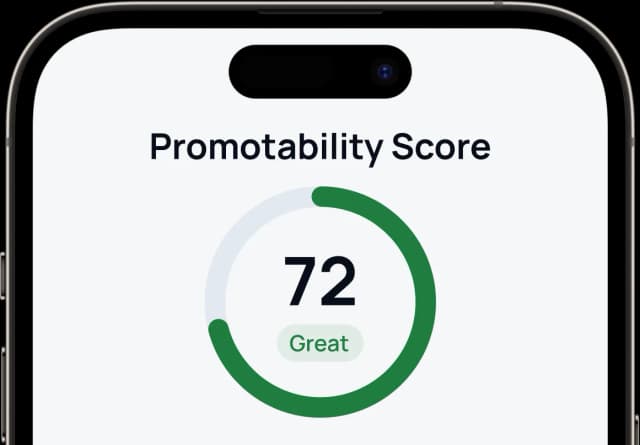
Find out where you actually stand
The CareerClimb app measures your promotion readiness across four pillars and tells you exactly what's holding you back.

Share this article
You think you're ready for a promotion. You've been at this level for two years, you're shipping work that matters, and you just watched someone with less experience get promoted ahead of you.
So either you're missing something, or the system is broken.
Usually, it's the first one. Not because your work isn't good enough. Because "good work" isn't what promotion decisions are based on. They're based on evidence, alignment, and visibility. Most people have no way to measure how they're doing on those things until the decision has already been made.
The problem with "feeling ready"
Feeling ready for a promotion is one of the least reliable signals in your career.
Research on self-assessment accuracy shows that people overestimate their readiness, particularly in areas where they have the least information. You might be doing excellent work. But if you don't know what the promotion committee evaluates, your self-assessment is built on incomplete data.
A 2025 survey from The Predictive Index found that 46% of employees believe their boss only somewhat or rarely understands their contributions. That perception gap runs both directions. Your manager may not see your full impact. And you may not see what your manager sees as missing.
The people who get promoted aren't always the ones who feel the most ready. They're the ones who can point to specific evidence across every dimension the decision-makers care about. Feeling ready is an emotion. Being ready is measurable.
Four things that actually determine promotion readiness
Promotion decisions depend on four things working together. Weakness in any one of them can stall you, regardless of strength in the others.
1. Documentation: do you have evidence?
Most promotion cases fail because of missing proof, not missing performance.
When your manager goes into the calibration meeting where your promotion gets decided, they need specific examples. Not "she's been doing great work." Specific deliverables, measurable outcomes, concrete moments of impact organized by the categories your company cares about.
Scullen et al. (2000) found that 62% of performance rating variance comes from rater bias. What your manager remembers matters more than what you did. And people forget roughly 67% of new information within 24 hours. If you didn't write it down, it probably won't make it into your case.
Ask yourself:
- Do you have a running record of your wins? Not a vague sense of accomplishment. Actual entries with dates, outcomes, and context. (Tracking accomplishments takes minutes a day and changes everything at review time.)
- Does your evidence cover multiple rubric categories? Shipping code alone won't get you promoted if leadership, mentorship, or cross-team impact are also in the rubric.
- Could someone else read your evidence and make your case for you? That's the test. Your manager has to advocate for you when you're not in the room.
2. Visibility: do decision-makers know your work?
You can have the best evidence in the company and still get passed over if the people making promotion decisions have never heard your name.
Visibility isn't self-promotion or politics. It's whether the evidence of your work has reached the people who decide your promotion. Your manager is one person. Calibration involves multiple people. If your skip-level, your tech lead, or your cross-functional partners can't back up your manager's case, that case is weaker than it needs to be.
Ask yourself:
- Does your skip-level know what you've accomplished this cycle? Not from your manager's retelling. From direct exposure to your work.
- Have you presented, demoed, or shared your work outside your immediate team? Written updates, tech talks, design reviews, and cross-team collaborations all count.
- If your manager got reassigned tomorrow, could someone else vouch for your impact? If the answer is no, your promotion depends entirely on one person's memory and political capital.
3. Manager alignment: is your manager on your side?
This is the pillar most people skip, and it's the one that matters the most.
Only 30% of employees say their manager involves them in goal-setting, according to Gallup. 46% say their manager doesn't even know how to help with career development. That means the majority of professionals are trying to get promoted without confirming that the person responsible for their promotion case actually supports it.
Your manager's opinion isn't just one input. It's usually the most important input. If your manager isn't advocating for you, the rest of your preparation has a ceiling.
Ask yourself:
- Have you had THE conversation? Not "how am I doing," but a direct conversation about promotion. "I want to be promoted in the next cycle. What do you think I need to get there?"
- Does your manager think promotion is possible for you this cycle? Not "eventually." This cycle.
- Have they told you what's missing? Vague encouragement ("you're doing great, keep going") is not alignment. Specific gaps and a shared plan is alignment.
68% of professionals who directly asked for a promotion received one. The conversation itself changes the outcome, because it forces your manager to either commit to supporting you or tell you what needs to change.
4. Clarity: do you know the rules?
You can't win a game if you don't know how it's scored.
Promotion criteria vary by company, level, and role. What got your teammate promoted at Google doesn't apply at Amazon. What worked at L4 doesn't work at L5. The jump from mid-level to senior requires different evidence than the jump from senior to staff.
Ask yourself:
- Have you read your promotion rubric? Not skimmed it. Actually read it and understood what each criterion means at your target level.
- Do you know the review timeline and decision process? When nominations happen, who decides, what the calibration process looks like.
- Can you name the gap between where you are and where you need to be? If you can't articulate the specific delta, your preparation is directional guessing.
Most engineers have never actually read their rubric. They operate on assumptions about what promotion requires, inherited from peers or absorbed from the culture. Those assumptions are usually incomplete and sometimes wrong.
Why these four things work together (and what happens when one is missing)
Each pillar compensates for weaknesses you can't see from inside your own career.
Strong documentation but no manager alignment means your manager goes into calibration without a plan to advocate for you. The evidence exists, but nobody is using it.
Strong visibility but weak documentation means people know your name but your manager can't cite specifics when challenged. "Everyone knows she's good" doesn't survive a promotion committee asking for examples.
Strong manager alignment but no clarity means your manager wants to help you, but neither of you is working against the actual criteria. You're both building a case for the wrong rubric.
Strong clarity but no visibility means you know exactly what's required but the people making decisions don't know you've done it. You're perfectly prepared for a meeting you're not invited to.
The professionals who get promoted have all four in reasonable shape. Not perfect — reasonable. And they know which one is weakest.
The caps most people don't realize exist
This framework is honest instead of motivational because it has hard limits.
You can't score above 50 until you've had the manager conversation. Documentation, visibility, rubric knowledge: none of it gets you past the halfway point until your manager knows you're pursuing promotion and has given you direct feedback. This is the single highest-leverage action most professionals haven't taken.
You can't score above 80 until your manager confirms promotion is possible. There's a difference between "I support you" and "I believe this can happen this cycle." Until your manager gives you the second signal, your case has a ceiling that no amount of evidence will break through.
You can't score above 90 without balanced evidence. Being exceptional in one category while empty in another is how borderline cases lose in calibration. The committee sees the gap.
These caps exist because they match how promotion decisions actually work. A perfect evidence portfolio doesn't matter if your manager isn't fighting for you. A supportive manager can't save you without evidence. And none of it works if you've misread the rubric.
How to measure where you actually stand
You could audit yourself against these four pillars manually. Honest answers to the questions above would give you a rough picture.
But honest self-assessment is hard. Research shows that people are worst at evaluating themselves in areas where they have the least competence. The person who most needs to improve their visibility is usually the one who thinks visibility is fine. The person who most needs the manager conversation is the one who assumes their manager already knows.
The CareerClimb app built its Promotability Score around this framework. It measures your promotion readiness across all four pillars and gives you a concrete number instead of a feeling.
The hard caps are built into the score. If you haven't had the manager conversation, your score can't exceed 50 no matter how strong everything else looks. The app doesn't let you pretend that away. It tells you exactly what's capping your readiness and what action removes the cap.
Your score updates as you take action. Log wins and your documentation pillar climbs. Have the manager conversation and the cap lifts. Upload your rubric and your clarity score sharpens. You're measuring progress against specific inputs you control, not hoping that effort alone translates to outcomes.
Harkin et al. (2016) analyzed 138 studies and found that monitoring progress improves goal attainment (d = 0.40). Measuring where you stand changes behavior. Knowing the number makes you act on it.
 CareerClimb
Stop guessing where your case stands.
See exactly where you stand — free.
Readiness is not a feeling
"Am I ready for a promotion?" has an answer. Not a gut check. Not your manager's vague encouragement. A structured answer based on whether you have evidence, whether the right people know about it, whether your manager is aligned, and whether you understand what's required.
Most people never get that answer because they never measure. They wait, hope, work hard, and find out where they stand when the decision has already been made.
You can find out now instead.
Find out where you actually stand. The CareerClimb app measures your promotion readiness across four pillars — documentation, visibility, manager alignment, and clarity — and tells you exactly what's capping your score. Download CareerClimb free and get your Promotability Score.