When Is It Time to Quit Your Job?


 CareerClimb
Wondering if it's time?
Get clarity on whether to stay or go.

Share this article
You've been asking yourself this question for three months. Maybe six. Every Sunday night it comes back. You make the pros-and-cons list, you convince yourself things will get better, you talk yourself down. Maybe this is just a rough patch. Maybe you're being impatient. Maybe leaving would be a mistake.
Or maybe you've been lying to yourself, and some part of you already knows it.
This article isn't going to tell you to follow your passion or that life's too short for a job you hate. You're past that. What you need is a framework for telling the difference between temporary difficulty and structural problems, because those require completely different responses.
The question most people get wrong
The common way to frame this decision is: am I happy here? That's the wrong question. Every job has stretches that aren't fun. Projects go sideways. Managers go through difficult phases. Teams lose good people. Unhappy is normal in bursts. Unhappy for months at a time with no visible reason to think it will change is something else.
The better question is: can this actually change?
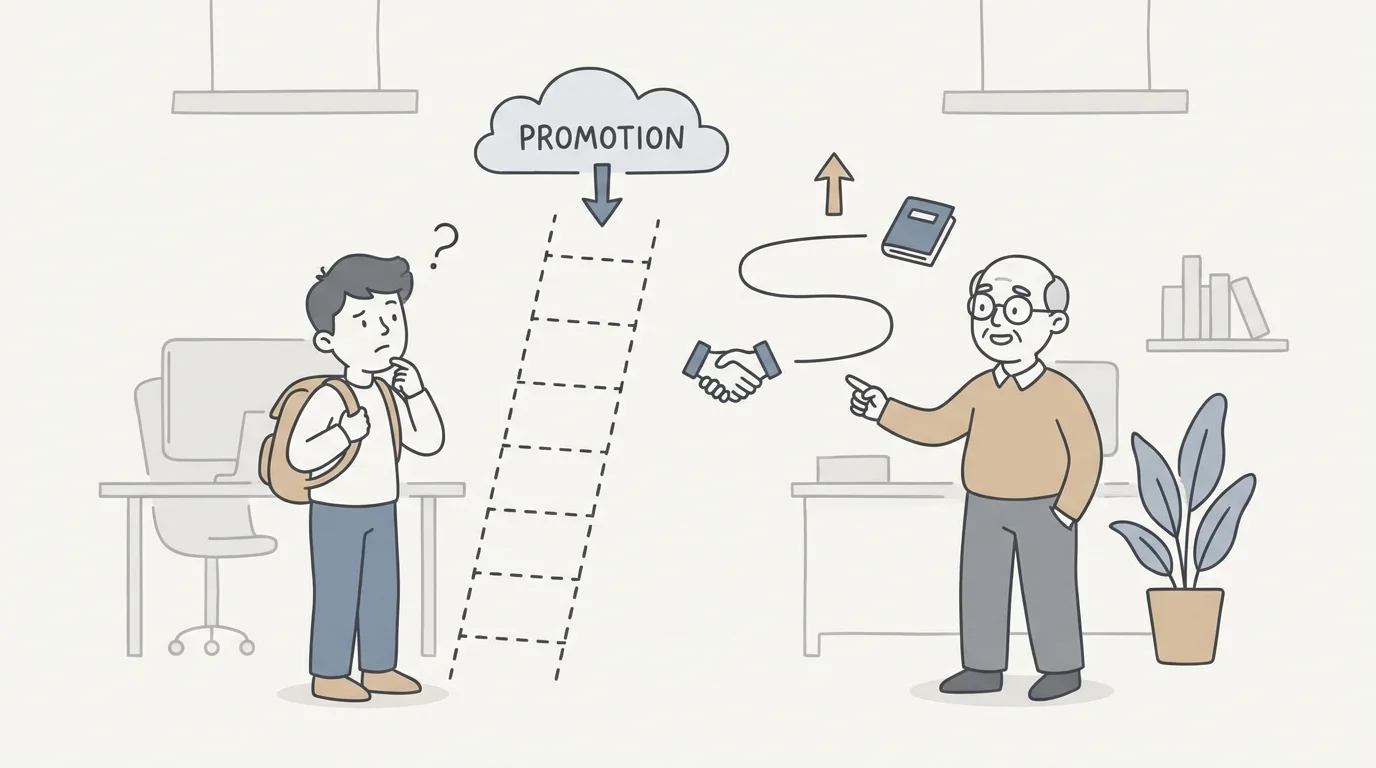
Some things are fixable. Some aren't. Your manager being overbearing is potentially fixable: you can change teams, you can have a direct conversation, the manager can leave. Your company having no promotion path beyond senior engineer is structural. Working harder won't solve it. Waiting won't solve it. The ladder ends where it ends.
The work of making this decision is learning to tell the difference.
Five signals worth evaluating
Not every complaint belongs on this list. "My commute is annoying" is not a signal. "I don't like the new office design" is not a signal. The signals below describe situations where something that matters (your growth, your pay, your future options) is being affected in ways that are likely to persist.
Compensation trajectory
The relevant number isn't your current salary. It's whether your compensation has kept pace with your market value over time.
For most of the early 2020s, changing jobs was the reliable mechanism for pay increases. According to ADP Pay Insights data from 14.8 million employees, job switchers saw a median 16% pay increase over stayers at the height of the Great Resignation in 2022. That gap has narrowed considerably. As of early 2026, the switching premium is near a record low, and CNBC reported that wage growth for job stayers has recently eclipsed job switchers.
The signal isn't "I could make more somewhere else." That's almost always true. The signal is whether your compensation has stagnated despite consistent strong performance, and whether your employer has given you any honest indication it's going to change.
The invisible ceiling
Not every company has a staff or principal track. At many mid-size organizations, the ladder genuinely ends at senior. If you've been senior for three or more years, have gotten consistent strong reviews, and still have no credible path to the next level, that's worth naming clearly.
On Team Blind, threads like "Permanently stuck as a Senior Software Engineer" and "Stuck as a Senior Engineer for 14 years" surface the same pattern repeatedly: engineers who did everything they were supposed to do and hit a ceiling that turned out to be structural, not temporary. The diagnosis wasn't that they needed to get better. The ceiling was real.
This matters because the answer to a structural ceiling is different from the answer to "I haven't quite built my case yet." One requires patience and a plan. The other requires a different company.
Your manager relationship
Manager quality has an outsized effect on career trajectory. Your manager controls your visibility during calibration, who fights for you when promotion decisions happen, and whether you get access to the work that builds your case.
A bad manager is potentially fixable. You can switch teams internally. Managers leave. Sometimes the relationship improves with a direct conversation. But if you've been in this role for more than 18 months with a manager who doesn't advocate for you, doesn't give you feedback you can act on, or actively obscures your work from leadership, and you've already had the direct conversation about it, that's a signal the situation isn't going to self-correct.
Ask yourself: if your manager were replaced tomorrow with someone excellent, would the structural situation improve? If yes, the manager is the problem. If no, the manager is a symptom.
Values drift
This one is harder to quantify but easier to feel. Values drift is when the work your company asks you to do, or the way it asks you to operate, has moved away from what you're willing to do.
Common versions: a company that deprioritizes quality in ways you can't get behind. A culture that rewards politics over output, consistently and visibly. A shift in business direction that makes the work feel pointless. A set of layoffs handled in a way that told you how leadership thinks about people.
Values misalignment is structural by definition. You can't fix it from your position. You either adapt your values, which isn't always possible or right, or you leave.
Market timing
The tech job market in 2025-2026 is not the market of 2021-2022. PayScale's analysis puts average tech salary growth at 1.6% in 2025. The conditions that made job-hopping a reliable pay strategy have cooled off.
What this means practically: if your reason for leaving is primarily financial, the timing is harder than it was three years ago. If your reason is structural (no path, values misalignment, a ceiling you can't break through), timing is less relevant. Staying in a bad situation longer because the market is soft doesn't fix the situation. It just delays it.
The sunk cost trap
Here's the version of this that keeps people stuck longer than almost anything else: "I've been here four years. If I leave now, that's four years wasted."
It isn't. But the feeling is real, and it has a name.
Kahneman and Tversky's research on loss aversion established that humans experience losses roughly twice as powerfully as equivalent gains. Applied to careers: the prospect of losing the years you've invested, the relationships you've built, the domain knowledge you've accumulated: that loss feels enormous. So you stay.
The National Institutes of Health (NIH)'s career training office describes the dynamic as "letting your future self suffer to please your past self." Your past self made a reasonable decision with the information they had. Your current self has new information. Those are different decisions.
The years don't vanish when you leave. The experience comes with you. The question is whether staying another year makes the next year better, not whether the previous years count.
Is this fixable or not?
Research on why people leave jobs consistently identifies two categories: push factors (problems with the current employer) and pull factors (external opportunities). Studies published in the ACM Digital Library find that internal push generally matters more than external pull. Most people leave because something is wrong where they are, not because they got a better offer elsewhere.
The useful question for each problem you're carrying isn't "does this bother me?" It's "can it actually change?"
Your manager situation can change if the problem is the person, not the culture. If you've adjusted your approach, had the direct conversation, and nothing shifted in 12 months, the problem is probably structural.
Your compensation can change if you have leverage, the business is healthy, and your manager will push for it. If the company is in a budget freeze and your manager has been honest that constraints are real, it probably won't.
Your promotion path can change if you haven't yet built your case and the level above you exists. If you've been passed over multiple times despite strong performance, or the next level simply doesn't exist at this company, that's structural.
When the honest answer to most of these is "probably not," you have your answer.
How to make the decision you won't regret
Regret usually comes from two places: leaving for the wrong reasons, or staying too long.
Leaving for the wrong reasons often means confusing temporary difficulty with structural problems. A hard quarter isn't a sign to leave. A difficult project isn't a sign to leave. A frustrating few months where you can point to specific causes: those usually resolve.
Staying too long usually means knowing for months that the structural problems aren't going to fix themselves, but finding reasons to wait: the next review cycle, the upcoming comp adjustment, the new manager who might be different. On Team Blind, engineers describe staying for "one more promo cycle" for years, resetting the timer every time it runs out.
If you've had the direct conversations with your manager about path and compensation. If you've genuinely given the situation time to change. If the signals above point clearly toward structural problems rather than temporary ones. Then the decision isn't really in question anymore. It's just uncomfortable to act on.
The engineers who report the least regret describe a common pattern: they left when the evidence was clear, not when the emotion was at its peak. Not rage-quitting. Not chasing a feeling. They had looked clearly at the structural situation, decided it wasn't going to change, and made the move.
That's the version you're trying to get to.
What comes next
The decision to leave a job and the decision to start looking aren't the same thing. Most people start looking before they've fully committed to leaving, using the market as a way to test their own conviction.
That's fine. But if you've been passed over repeatedly despite putting in the work, or if a specific event (a PIP, a bad review, a denied promotion) crystallized that something was fundamentally wrong, the framework above gives you something more useful than a feeling to act on.
When you do make the move, the transition itself matters as much as the decision to leave. Leaving well, on your own terms, with a clear story about why you're going, sets up the next chapter better than leaving in a reactive moment.
If you're still at your current company and not yet sure whether the path forward is real, CareerClimb's Artificial Intelligence (AI) coach Summit helps you log wins, track your promotion progress, and see clearly whether the case you're building has anywhere to go. Sometimes the answer is yes. Download CareerClimb.