What to Do When Your Boss Texts You at 11pm

 CareerClimb
Boss won't respect boundaries?
Get coaching on how to set limits without hurting your standing.

Share this article
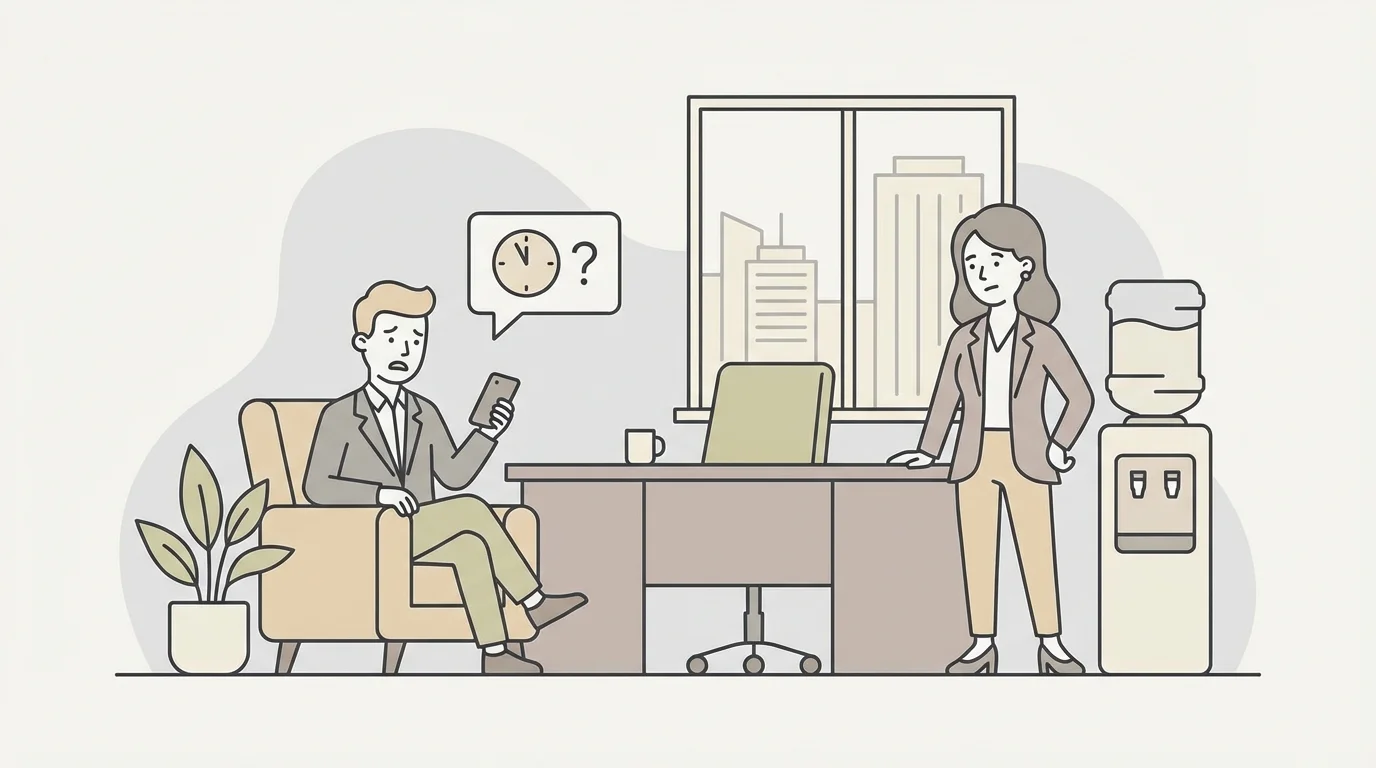
It's 11pm on a Thursday. You're watching something with your partner, or reading, or almost asleep. Your phone lights up. It's your manager.
You read it before you can stop yourself. Now you're in the loop: Is this urgent? Do they expect a reply tonight? If I don't respond, will it look like I'm ignoring them? And regardless of what you decide, the thing you were doing before the message is gone.
If this happens occasionally, it's probably not a pattern worth addressing. If it happens regularly (Sunday evenings, late weeknights, vacation days), the question isn't whether to respond to this message. The question is how to stop the next hundred.
Is this actually urgent?
Most people skip this question and go straight to: should I respond? But before you can make a good decision in the moment, you need a clear sense of what "urgent" actually means.
Department of Labor guidance describes a work emergency as an unforeseen situation that threatens employees, customers, or the public, or one that disrupts operations or causes physical or environmental damage. That's the bar. Production down, security incident in progress, something that genuinely cannot wait until 9am.
Most late-night messages from managers are not that.
Signals that it's genuinely urgent:
- A production outage or security incident affecting real users
- A hard regulatory or legal deadline that is literally tonight
- A personnel or safety situation that requires your specific input right now
Signals that it's not:
- Strategy questions, planning discussions, or feedback requests
- Scheduling or meeting prep
- Forwarded articles with no ask attached
- Anything that opens with "when you get a chance" or "no rush," but arrives at 11pm anyway
The channel matters too. A phone call signals that something needs immediate attention. A Slack message or text does not, even when managers use the format to create that feeling. Watch for managers who send chat messages when an email would have done the same job. It's often not a conscious manipulation. It's just a habit that bleeds into your evening.
Frequency is the most honest signal. Genuine emergencies are rare. If your manager contacts you outside work hours every week, or most weekends, that's not a series of emergencies. That's an expectation.
What happens when you see the message
Research on after-hours contact is fairly consistent on one point: the damage isn't in the responding. It's in the seeing.
A 2021 study from researchers at Virginia Tech, Lehigh University, and Colorado State found that organizational norms (even unwritten ones) around after-hours availability create a "constant state of anxiety and uncertainty" that prevents psychological recovery even on nights when no messages arrive. The mere expectation is the problem.
This tracks with how workers describe the experience. The pattern that comes up again and again: "Even if I don't respond, I already saw it. The damage is done." The message forces you to run a decision loop (urgent or not? respond or wait?) and that loop consumes real mental energy regardless of what you decide.
A related line of research on on-call workers found that being available by phone on a day off produces measurable cortisol elevation and reduced mood even on nights when no calls come. The physiological cost isn't triggered by contact. It's triggered by the possibility of contact.
If your manager texts you at 11pm twice a month, and you respond each time, your nervous system isn't just processing two messages per month. It's running on low-grade alert every evening.
What to do in the moment
If it's not a genuine emergency, don't respond tonight. That's not passive aggression or insubordination. It's you not rewarding a behavior that erodes your recovery time.
The harder part: many people respond anyway, not because they think it's urgent, but because they're worried about how non-response will look. If your manager is a reasonable person, not responding tonight will not harm your career. If not responding to a non-urgent 11pm message actually would harm your career, that's information about the culture, not about you.
Here's the more insidious version: you respond once, immediately, to a clearly non-urgent Sunday message. Maybe it was a bad week and you wanted to look engaged. Your manager takes that as evidence that you're available. The next Sunday message arrives. You've established a contract without meaning to.
Career coach Beth Stallwood put it directly: "They might well have taken your replies as permission to keep doing it."
The rule that actually works: if you wouldn't call a colleague at 11pm with this information, your manager probably doesn't need a reply tonight either. Set a reminder to respond at 9am and put the phone down.
If you're in an on-call rotation or a role where genuine emergencies are part of the job, establish a distinct channel for those: a phone call, a PagerDuty alert, a designated escalation path. That separation makes the boundary concrete. Slack is not urgent. A call is.
The conversation that changes the pattern
At some point, not responding in the moment isn't enough. If the pattern is consistent, you need to name it.
Most managers who do this don't realize the effect it has. They send messages when they think of things, without tracking whether it's 11pm or 11am. They're not trying to dominate your evenings. They're just operating without awareness of the cost. When told directly, many of them adjust. This kind of boundaries conversation is also a good opening for the broader discussion about how you work best. The same 1:1 is a natural place to talk to your manager about your career expectations.
The framing that works best is functional, not emotional: you're not asking for a favor, you're explaining what allows you to work well.
"I want to flag something about how I work best. When I get messages in the evening, I end up thinking about work until I fall asleep, which means I come in less sharp the next day. I'd like to agree on something: if there's a genuine emergency, something that truly can't wait until morning, call me directly. For everything else, I'll pick it up first thing. Does that work?"
A few things this framing does well:
-
It's business-focused. You're not asking for work-life balance as a lifestyle preference. You're explaining a performance factor. That's harder to dismiss.
-
It gives the manager a clear emergency path. A lot of after-hours texting happens because managers are anxious and want to know they can reach you. Giving them a real escalation channel (phone call = urgent) removes the ambiguity without leaving them feeling cut off. You're not asking to be unreachable; you're asking to be reached through the right channel.
Some managers will say they never expect you to respond immediately and you're free to wait until morning. If that's true, you can respond: "That's good to know. I've been treating them as more urgent than they are. I'll start responding in the morning." That conversation is often enough to reduce the frequency on its own.
If the response to a calm, direct, professional conversation about communication timing is friction or retaliation, that's not a boundary issue anymore. That's a difficult manager problem, and the path forward is different. Persistent after-hours pressure is one variant of the broader control pattern covered in how to deal with a micromanager: the underlying dynamic and the communication strategies that work are similar.
When it's not just your manager
One manager texting at odd hours is usually fixable. When multiple managers across a team do it, when peers describe the same experience, when junior employees feel pressure to stay visibly online on weekends, that's not a disorganized individual. That's culture.
The signals that distinguish an individual habit from a systemic expectation:
- After-hours response time is referenced in performance conversations or reviews
- New employees observe everyone online on weekends and start mirroring it without being asked
- Non-response to after-hours contact leads to visible friction or missed information the next day
- When you mention the pattern to peers, the response is "yeah, that's just how it is here"
- The frequency increases when you don't respond, rather than tapering off
If you're in that kind of environment, the conversation with your manager may still be worth having. But your results will depend on whether your manager is an individual actor or a product of the culture around them. If they got where they are by being the most responsive person in the room, they may not have much incentive to help you be less so.
A 2024 review of 23 studies in PLOS Digital Health found that supervisor availability expectations amplify the negative effects of off-hours smartphone use on wellbeing more than the messages themselves. The problem isn't the technology. It's what the organization signals about how the technology should be used.
That's worth knowing if you're evaluating whether the role is sustainable, or trying to figure out whether the pattern will change once you've had the conversation. In a culture where after-hours availability is a proxy for dedication, individual conversations rarely hold. If the pattern is systemic and shows no signs of changing, it becomes one of the clearer signals in deciding when it's actually time to leave.
Staying ahead of it in future roles
The Skynova survey on after-hours contact found that 90.4% of workers felt these expectations should be discussed during hiring or onboarding, but only 60.6% of them actually received that conversation. That gap is where the problem starts.
When you're evaluating a new role or team, ask directly: "What does your team's communication culture look like outside core hours? Are there expectations around evening or weekend availability?" The answer tells you something about the environment before you're in it.
When you're starting a new role, you have a brief window to establish your own norms before the implicit contracts form. If your new manager sends a Sunday evening message in week two, your response (or non-response) starts to set expectations. It's easier to establish a pattern early than to unlearn one six months in. One of the most effective ways to reduce after-hours contact is making yourself reliably visible during work hours: a short weekly update to your manager reduces the anxiety-driven check-ins that often spill into evenings.
If you're building your case for a promotion, how you manage your time and capacity matters. CareerClimb's Artificial Intelligence (AI) coach Summit helps you track your work, document your wins, and build the kind of sustainable work habits that show up in reviews, without the grinding availability spiral. Download CareerClimb.