Pinterest Cut 700 People and Fired the Engineers Who Tried to Find Out Who. Here's What That Tells You.

 CareerClimb
Worried about your job?
Get a plan to protect your career — starting today.

Share this article
On January 27, Pinterest announced it was cutting roughly 700 employees, about 15% of the company. CEO Bill Ready framed it the way every tech CEO frames it now: an AI pivot. Resources would be "reallocated" to AI-focused roles. The restructuring would take until September.
The stock dropped 9%.
That's the first thing that makes Pinterest different from Block and Atlassian. When Block cut 40% of its workforce, the stock jumped 17%. When Atlassian cut 10%, the stock ticked up. Wall Street read those as confidence moves: profitable companies getting leaner. Pinterest's stock dropped because the market didn't buy the narrative. The company had just missed Q4 revenue estimates, posted soft guidance for Q1, and disclosed that tariff-driven pullbacks from large retail advertisers were hitting ad revenue. This wasn't a company streamlining from strength. It was a company struggling with growth, and investors could tell.
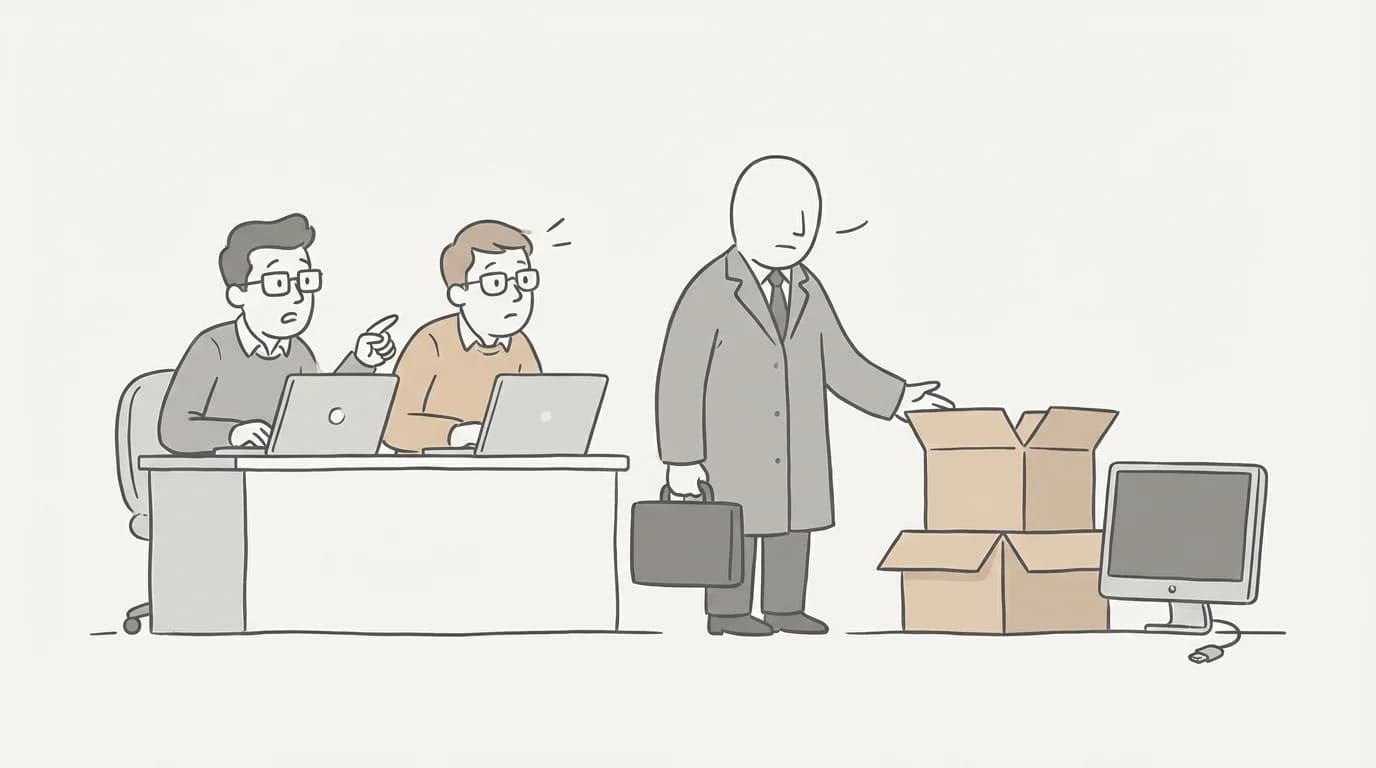
Then things got worse. Pinterest's chief security officer told engineers the company would not release the names of laid-off employees, citing privacy. Two engineers responded by sharing instructions on how to use the company's internal staff directory to figure out who had been deactivated. Some reports say they built a script that tracked Slack deactivations. Either way, the intent was the same: help coworkers find out who was gone, since leadership wouldn't say.
Pinterest fired them both. CEO Ready called the behavior "obstructionist" at a company-wide town hall and told remaining employees that if they were "working against the direction of the company," they should consider leaving.
On Blind, nearly half of respondents in a poll said the engineers were punished for curiosity. Another 28% said it wouldn't have happened if leadership had been transparent in the first place. One commenter: "They didn't leak to the press or sell data. They were just trying to figure out who was impacted since leadership failed to communicate."
Fortune's headline captured what many felt: "Pinterest cracks down on dissent, fires engineers for an internal layoff tool as AI shake-ups keep employees on edge and in line."
The Pinterest situation is three problems at once
Most layoff articles treat a layoff as one event with one set of responses. Pinterest is three overlapping problems, and each one changes what you should do.
Problem 1: The company's strategic direction is unclear, even to investors. A layoff at a company with a rising stock price is stressful but directional. You can at least figure out where the company is heading and position yourself there. Pinterest's stock dropped on the layoff announcement, then dropped another 17% on the earnings miss two weeks later. Q4 revenue of $1.32 billion missed estimates. Q1 guidance came in soft. The company cited tariff exposure hitting its retail advertising base, a headwind specific to Pinterest's advertiser mix that competitors like Meta and Google didn't face as acutely.
For engineers inside Pinterest, this means the ground is shifting and nobody's handing out maps. When even the market isn't sure what comes next, positioning yourself for "where the company is heading" is harder because the destination isn't clear.
Problem 2: Asking questions is now dangerous. The two fired engineers weren't whistleblowers. They didn't leak confidential data externally. They helped colleagues identify who'd been laid off. That information the company chose to withhold. Whether you think they crossed a line or not, the message to remaining employees was unambiguous: questioning leadership decisions during a restructuring can cost you your job.
On Blind, engineers described the aftermath as a chilling effect. Morale entered "basic survival mode." Candidates with pending offers reconsidered, citing "subpar stock performance" and uncertainty about the company's future. That's the environment 3,900 remaining employees are working in, one where the instinct to stay quiet and avoid attention is reinforced by a concrete example of what happens when you don't.
Problem 3: The AI framing may be a distraction from the real issue. Pinterest's stated reason for the cuts was the same as everyone else's: reallocating resources to AI. But the financial picture tells a different story. Revenue growth was slowing. The ad business was losing wallet share from large retailers pulling back due to tariff uncertainty. The restructuring was saving roughly $100 million in annual operating expenses, with half earmarked for "reinvestment in sales and AI."
That framing (cut costs, then call it an AI investment) is different from Block's aggressive ideological bet on AI replacing human work. Pinterest isn't saying AI makes its people obsolete. It's struggling financially and using AI as the narrative wrapper. The practical difference for engineers: the threat isn't that your work category is being automated. The threat is that you're at a company whose core business is under pressure, and the layoffs are a symptom, not a strategy.
How to assess whether your company has the Pinterest problem
Not every layoff is a Pinterest-style situation. Here's what makes it distinct:
The stock drops on the layoff announcement. This is the clearest signal. When the market rewards a layoff (Block, Atlassian), investors believe the company will be stronger post-cuts. When the market punishes a layoff, investors don't buy the story. If your company announces a restructuring and the stock drops, the market is telling you something your CEO isn't.
Leadership restricts information during the restructuring. Pinterest didn't just avoid sharing who was laid off. It actively punished employees who tried to find out. If your company is controlling information flow during a layoff more aggressively than usual, that's often a sign leadership doesn't have a coherent story to tell. Transparency is easy when you're confident in the direction. Opacity correlates with uncertainty.
The stated strategy doesn't match the financial picture. Pinterest said it was investing in AI. Its financials showed slowing revenue growth and tariff headwinds. If your company is framing cost cuts as strategic investment but the numbers tell a different story, the "strategy" may be rationalizing decisions driven by financial pressure.
Dissent is met with consequences, not conversation. Healthy organizations can absorb difficult questions. Ready's response, calling the engineers obstructionist and telling dissenters to leave, is a red flag not because the engineers were necessarily right, but because it signals an organization that cannot tolerate scrutiny during its most uncertain moment. That kind of leadership makes it harder to get accurate information about where you stand.
What to actually do if you recognize this pattern
The advice here is genuinely different from what applies at Block or Atlassian because the underlying problem is different. At Block, the threat was role-category automation. At Atlassian, it was R&D-specific restructuring. At Pinterest, the threat is being at a company whose direction is unclear and whose leadership has shown it will punish questions.
Assess the company's trajectory, not just your own performance. At a Block or Atlassian, you can game-plan around positioning your work toward where the company is heading. At a company like Pinterest, you first need to decide whether the company has a clear enough direction to position toward at all. If the stock is dropping, the revenue is slowing, and the CEO is framing cost cuts as innovation, that's a data point about the company's future, not just this quarter's headcount.
Build your external options before you need them. At a company with strong direction, it makes sense to focus on internal positioning. At a company where the strategic picture is murky and the culture has turned punitive, your energy is better spent building options outside. This doesn't mean rage-quitting. It means one conversation per month with someone outside your company. Keeping your resume current with quantified impact, not just project names. Making sure your network knows you exist before you need to ask it for something.
The engineers who land quickly after layoffs aren't the ones who start networking the week they get cut. They're the ones who maintained warm relationships during good times. If the Pinterest situation teaches you anything, it's that the week after a layoff is too late to start.
Decide whether to stay or go based on the culture, not the severance. Pinterest's restructuring charges suggest a real severance budget, but the amount doesn't change the underlying question. If you're at a company where asking questions gets you fired, where morale is in survival mode, and where the market doesn't believe in the strategic plan, the honest question about when to leave deserves a real answer. Surviving a layoff at a company with a broken culture is not the same as being in a good position.
What Pinterest adds to the picture
Block showed that a profitable company could frame AI as justification for cutting 40% of its workforce and be rewarded for it. Atlassian showed that engineering itself could be the primary target, with R&D taking more than half the cuts. Pinterest showed something different: that a layoff at a company losing direction is not the same animal as a layoff at a company with a clear (if painful) vision.
At Block, the career question was "is my work the kind AI replaces?" At Atlassian, it was "is my engineering org being restructured around me?" At Pinterest, the question is simpler and harder: "does this company have a future I want to be part of?"
The engineers who come through periods like this aren't necessarily the ones who survived every round. Sometimes the strongest move is recognizing that the restructured company isn't where you want to build your career, and making that decision on your own timeline, with options already in place, instead of waiting for the next round to make it for you.
CareerClimb helps engineers document wins, build their case, and stay ready for whatever comes next: a promotion, a restructuring, or a conversation with a recruiter. Download the app and start building your case today.