What Counts as a Win When Your Job Is Shipping Code

 CareerClimb
Not sure what counts as a win?
Get clarity on what's worth logging — and what's not.

Share this article
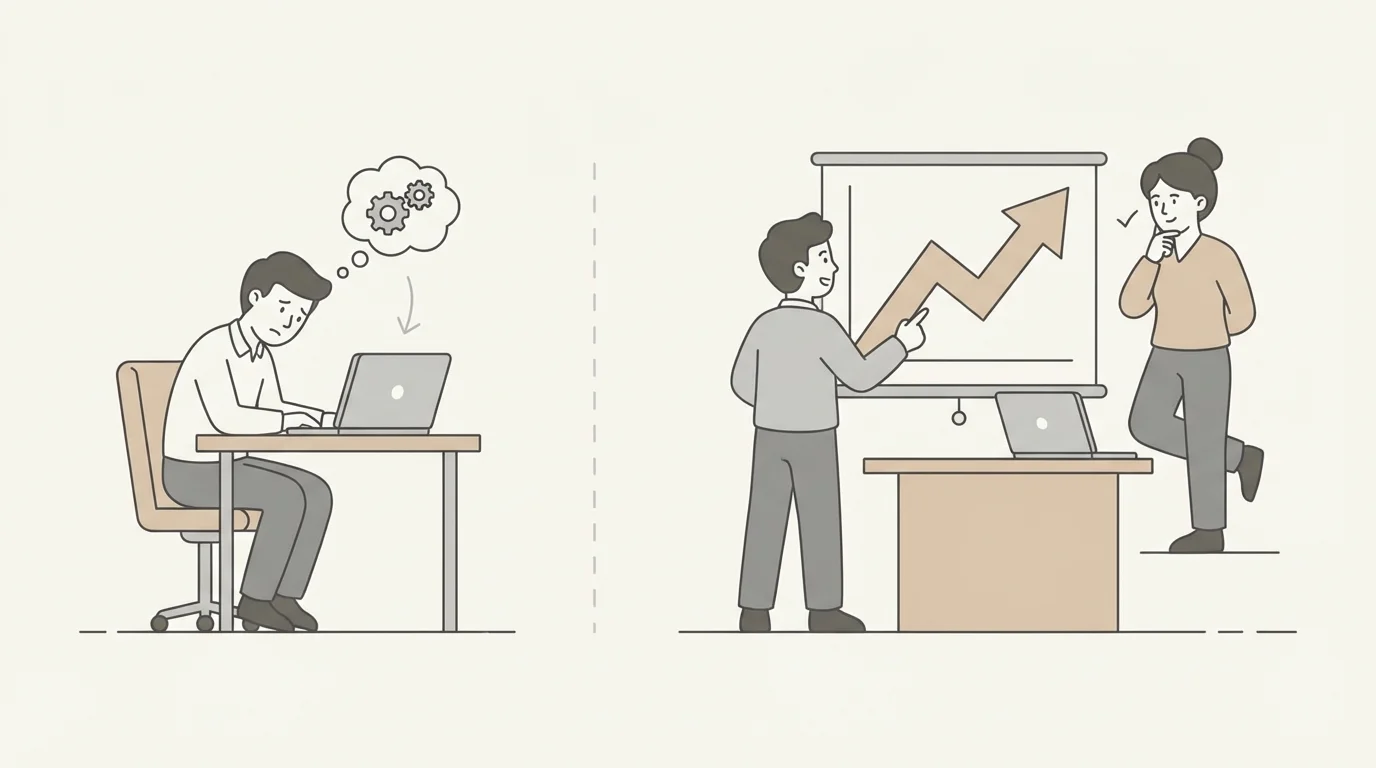
You shipped three features this quarter. You fixed a pile of bugs. You reviewed your teammates' PRs. You stayed up late debugging a production issue. When self-review time rolls around, you write: "Shipped feature X, feature Y, and feature Z."
Your manager reads it and thinks: yes, you did. That's your job.
This is the trap most engineers fall into. They think of "wins" as shipped features — things with tickets, PRs, and release notes. So when they sit down to document their accomplishments, they produce a task list instead of a promotion case. The calibration committee doesn't need to know you shipped three features. They need to know what changed because you were the one who shipped them.
The problem isn't that your work lacks impact. It's that you're measuring impact in the wrong units. Shipped code is an input. What the code accomplished is the output. And at most tech companies, promotions are awarded for outputs.
The categories of wins that actually matter
Calibration committees at companies like Google, Meta, and Amazon don't evaluate engineers against a checklist of features shipped. They evaluate against dimensions: scope, impact, technical complexity, leadership, and multiplying others. Your wins need to map to those dimensions.
Here are the categories that actually move a promotion case, with examples engineers typically overlook.
Technical impact wins
These are the wins most engineers recognize — projects that changed a system, improved performance, or built something new. The key is describing them in terms of outcomes, not deliverables.
What engineers write: "Built the new search indexing pipeline."
What calibration wants: "Built the search indexing pipeline that reduced query latency from 400ms to 80ms and enabled the product team to ship autocomplete, which increased search conversion by 15%."
The pipeline is the mechanism. The latency reduction and conversion lift are the wins. If you only describe the mechanism, you're asking the reader to infer the impact. Don't make them infer. State it. Reframing output as impact in your promotion case follows the same logic — every output statement needs a "which led to" clause before it belongs in a promo packet.
Problem identification wins
These are wins most engineers completely miss. Identifying a problem before it becomes a crisis is often more valuable than fixing a problem everyone already knows about.
Examples:
- You noticed that test flakiness was masking real failures and built a report that exposed 12 previously hidden bugs
- You identified a cost anomaly in your team's cloud spend before the monthly bill arrived and prevented a projected $40K overage
- You flagged a security vulnerability in a third-party dependency before it was exploited
Problem identification demonstrates judgment, ownership, and the ability to see beyond your immediate scope — exactly the signals that separate "doing your job" from "operating at the next level".
Multiplier wins
These are wins where you made other people more effective. Calibration committees love multiplier wins because they demonstrate scope beyond individual contribution.
Examples:
- You built a shared testing framework that three teams adopted, cutting their test setup time from 2 hours to 15 minutes
- You wrote documentation for a complex internal system that became the onboarding reference for every new engineer on the team
- You created a reusable CI/CD template that five services migrated to, eliminating 30 hours/month of per-team pipeline maintenance
The pattern: your work was used by people outside your immediate scope, and you can describe the aggregate impact.
Process and system improvement wins
Engineers often dismiss process work as "not real engineering." Calibration committees don't. Improving how a team operates is a direct demonstration of next-level thinking.
Examples:
- You redesigned the on-call rotation and runbook structure, reducing mean time to resolution from 45 minutes to 15 minutes
- You introduced a code review protocol that cut review turnaround from 48 hours to 8 hours
- You standardized deployment practices across your service area, reducing deployment failures by 60%
These wins are especially powerful for promotion because they show you're thinking about the system, not just your tickets.
Cross-team collaboration wins
Any time you drove work that required coordination across team boundaries, that's a win worth documenting. Cross-team work is the primary signal for scope at the senior and staff level.
Examples:
- You facilitated an API contract negotiation between two teams that had been blocked for three weeks
- You led a cross-team working group to align on a shared authentication standard
- You drove adoption of a new monitoring tool across four services owned by different teams
The key is being specific about what you drove versus what you participated in. "I was part of the migration effort" is a contribution. "I drove the migration plan, coordinated timelines across three teams, and resolved the blocking dependency issue" is a win.
Mentoring and leadership wins
If you're targeting senior or staff level, the committee expects to see evidence that you make others better. Your manager can't advocate for promotion on technical depth alone if the level requires demonstrated leadership.
Examples:
- You mentored a junior engineer through their first complex project, and they shipped it independently
- You led design reviews for your team's area, improving the quality of technical decisions before code was written
- You onboarded two new team members with a structured ramp-up plan that cut time-to-productivity in half
Don't describe mentoring as a feeling ("I supported my teammates"). Describe it as a system with outcomes.
Wins hiding in your daily work
Most engineers have more wins than they realize. They just don't recognize them because the work felt routine at the time. Here are common places wins hide.
Incident response. Every P1 or P2 incident you responded to is a potential win. You demonstrated judgment under pressure, technical debugging skill, and the ability to coordinate a response. Write down what happened, what you did, and what improved because of your response.
Design decisions. If you made a technical decision that the team followed, that's a leadership signal. If the decision turned out well — or if you identified a problem early that prevented a bad decision — document it.
Unblocking others. Every time a teammate came to you with a question and you unblocked them, that's a multiplier signal. You probably don't track these, but they add up. If it happens often enough, it's worth noting the pattern.
Things you said no to. Descoping a project to meet a deadline, pushing back on a bad technical approach, or rejecting a feature request that would have introduced tech debt — these are all demonstrations of engineering judgment. "I identified that the proposed approach would double our maintenance burden and proposed an alternative that achieved 80% of the value at 30% of the complexity" is a strong win.
How to capture wins you'd otherwise miss
The biggest risk isn't that you don't have wins. It's that you don't recognize them when they happen.
Weekly capture. Set a five-minute Friday reminder. Scan your week for anything that passes this test: would I mention this in a promotion case? Write it down in two or three sentences using the situation-action-result format. Most weeks you'll have one or two. Some weeks you'll have none. Over six months, you'll have a library. For wins that don't come with an obvious number — mentoring, cross-team coordination, code health work — there are five reliable ways to construct a number even when no dashboard tracked it.
Track the asks. When someone from another team asks you for help, write it down. When your manager asks you to represent the team in a meeting, write it down. When you're pulled into an incident, write it down. These are signals of trust, scope, and impact that don't appear in any ticket tracker.
Revisit old wins monthly. At the end of each month, reread your win log. Some things that seemed small when they happened turn out to be significant. That bug fix you did in week two may have prevented three incidents in weeks six through eight. Connect the dots.
You have more wins than you think. The gap isn't in your performance — it's in your documentation. CareerClimb's AI coach, Summit, helps you recognize and frame the wins hiding in your daily work, turning routine engineering into a promotion case that holds up in calibration. Download CareerClimb and stop letting your best work go undocumented.