What a PIP Does to Your Head

 CareerClimb
PIP messing with your head?
You're not broken. Get coaching to think clearly again.

Share this article
The day you get a Performance Improvement Plan (PIP), you're mostly fine during the actual meeting. You're in professional mode: asking questions, taking notes, nodding at the right moments. You sign the document acknowledging receipt.
Then you leave.
The drive home is when it starts. Or the moment you sit back down at your desk. Or the hour after dinner when you find yourself reconstructing the meeting word by word, trying to figure out if you missed something. You probably won't sleep well that night.
This article isn't about what to do next. There's time for that, and there are resources on the tactical questions. This is about those early days, before you're ready to act. The psychological experience that nobody names, because it doesn't fit neatly into an action plan.
If you still need to understand what a PIP is mechanically (the types, the timelines, what to look for in the first week), that's covered in a separate guide. This article is about what's happening in your head.
The Shame That Doesn't Feel Like Shame
Most people who get PIP'd don't say "I feel ashamed." They say they feel stressed, blindsided, anxious, or numb. Shame tends to disguise itself, especially in professional settings where we're trained not to have big feelings at work.
But what you're likely experiencing is shame, and it's different from ordinary stress in a specific, important way.
Researchers who study emotion draw a consistent distinction between shame and guilt. Guilt says: I did something wrong. Shame says: I am wrong. Guilt focuses on a specific behavior you can address. Shame indicts the whole self.
A PIP triggers shame rather than guilt because the document doesn't say "you made a mistake on project X." It says your performance (everything you produce, how you operate) isn't meeting expectations. That's a global judgment, not a correctable one.
Xing et al. (2021) in the Journal of Organizational Behavior found that negative feedback from supervisors directly triggers shame in employees, and that shame specifically correlates with emotional exhaustion and withdrawal tendencies. You pull back. You go quieter in meetings. You stop volunteering ideas. These aren't conscious choices. They're the shame response doing what it was built to do.
Daniels and Robinson (2019) describe workplace shame as one of the most powerful and least-discussed emotions in organizational life, partly because it's uncomfortable to name, and partly because workplaces give almost no framework for processing it.
One of shame's defining features is that it turns attention inward. When you're in it, you isolate: not just from the uncomfortable situation, but from the people and conversations that might otherwise help you process it. The shame and the isolation arrive together.
Why Your Brain Won't Stop
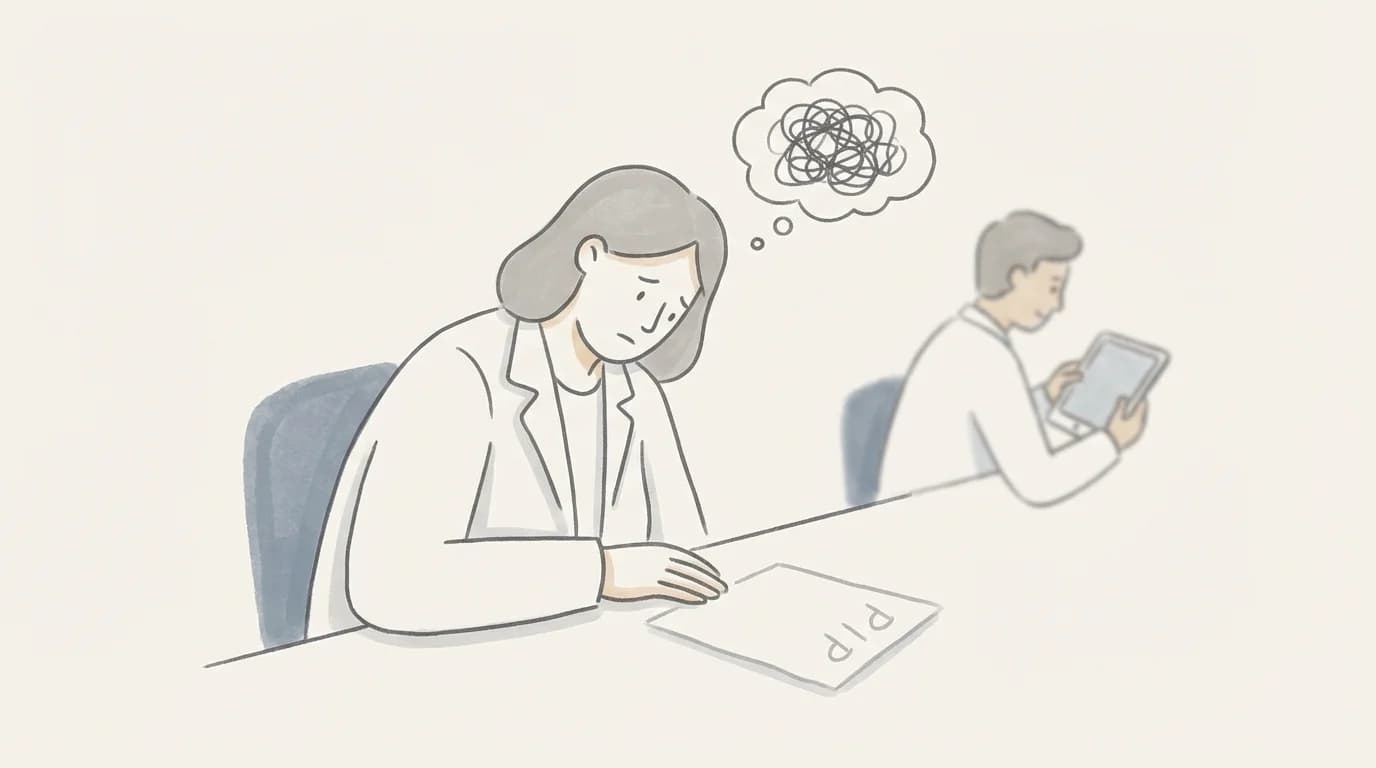
You know the behavior. You're re-reading Slack messages from three weeks ago, looking for signals you missed. You're replaying the last few 1:1 conversations, parsing the phrasing. Your phone is face-up on the desk when it would normally be in your bag.
This isn't paranoia. It's your threat-response system doing exactly what it was built to do.
When a key part of your identity is being judged negatively (which is what a performance evaluation does), your brain registers what psychologists call social-evaluative threat. A 2018 study on social-evaluative threat and cortisol response found that tasks involving negative social evaluation elicit some of the strongest cortisol stress responses measured in laboratory settings. The same stress hormone that fires during physical danger fires when your professional judgment is under formal scrutiny. This is not a metaphor.
What makes it worse is what happens next. Rumination (replaying the meeting, rehearsing what you should have said, imagining conversations that haven't happened yet) keeps your cortisol elevated long after the actual event. Research published in Psychoneuroendocrinology (2024) documents that state rumination following a major stressor is associated with significantly slower cortisol recovery. Your nervous system doesn't return to baseline the way it would after a neutral stressor. It stays activated.
Under sustained threat, the brain shifts into hypervigilance: a heightened scanning mode designed to detect further danger. A 2024 piece in Harvard Business Review describes workplace hypervigilance as a state where the nervous system doesn't trust that things are okay unless it's constantly checking. The Slack re-reading, the tone-analysis of your manager's messages, the replay of every meeting: that's hypervigilance.
The problem is what it does to your ability to work. Research on the hypervigilance feedback loop shows that this scanning mode consumes working memory and executive function, making it harder to do the work you're supposedly being evaluated on. The threat response impairs the very performance it's responding to.
Are You at Risk of a PIP?
Find out if you're missing the warning signs — before it's too late.
7 questions · about 2 minutes · free score
1 of 7
How did your last performance review compare to the one before it?
"I Thought I Was Good at This"
For a lot of engineers, the PIP hits an identity layer that goes deeper than a single job.
You built a career on being competent. You got hired somewhere competitive. You shipped things, owned things, got credit for things. Whatever your level, you accumulated evidence that you knew what you were doing, and you organized part of your self-concept around that evidence.
Threats to professional identity produce a qualitatively different kind of distress than ordinary work stress. A study in the Journal of Management and Organization on occupational identity threat documents that it promotes intense negative emotion and feedback-seeking behavior simultaneously. People in this position feel terrible and desperately want more information at the same time, which explains why the hypervigilance and rumination above become so all-consuming.
The specific way this lands for high performers connects to research on the imposter phenomenon. A 2024 study in Current Psychology found that individuals with higher imposter phenomenon scores tend to overgeneralize the implications of single failure experiences to their global self-concept. If you've privately wondered whether you're as competent as your title suggests (and many high performers carry this quietly), a PIP doesn't just threaten your job. It threatens the internal framework you've been using to hold that doubt at bay.
The question behind the question isn't "will I pass this PIP?" It's "was I ever actually as good as I thought?"
That's a heavier thing to carry than a performance document.
The Trust Collapse
A few days after getting the news, a different realization tends to arrive: your manager is now someone different to you.
Not dramatically different. But in every meeting, in every piece of feedback, in every message they send, there's an interpretive layer that wasn't there before. You're looking for what they mean rather than just hearing what they say. You notice when they don't respond quickly. You notice their phrasing.
Trust is fundamentally asymmetric. It takes sustained experience to build and can be damaged by a single event. What makes the PIP moment particularly disorienting is the gap it reveals: your manager has been documenting concerns, working with HR, building a paper trail, while your 1:1s may have felt like normal feedback conversations.
The gap between what was happening and what you understood to be happening is its own kind of disruption. You're not just recalibrating your relationship with your manager. You're recalibrating your confidence in your ability to read situations accurately, which is a different problem.
The surveillance feeling has a grain of reality to it. During a PIP, what you say and do IS being documented more deliberately than before. That's not paranoia. But the hypervigilant brain amplifies it until every word in every meeting feels like testimony.
Not Telling Anyone
The most isolating part of a PIP is that it's almost impossible to talk about.
You can't tell colleagues. The career risk is real, and the information changes how people see you before you've had any chance to respond to it. You can't tell most people at your company.
You might want to tell close friends outside work. But PIPs are particular enough that these conversations can go wrong in specific ways. Friends catastrophize or jump to tactics when you don't want tactics yet. Partners get scared. People who work in different industries apply frameworks that don't fit.
So you carry it privately. The question of who to tell and what to say is worth thinking through before those conversations happen.
Research on shame consistently finds that it intensifies in secrecy. When we can't name an experience to another person, its internal weight grows. The withdrawal response that Xing et al. (2021) identify as a core shame behavior isn't just about pulling back from work activities. It's about pulling back from the social contacts that might otherwise help process what's happening. The isolation and the shame feed each other.
This is the piece that doesn't appear in the official documentation. It's not in the PIP goals, not in the HR check-in notes, not visible to anyone managing the process. It's happening in the quiet hours, in the gaps between the scheduled checkpoints.
This Is Your Nervous System Doing Its Job
Here's the thing worth knowing, even if it doesn't make anything easier right now:
What you're experiencing has a name. The shame, the hypervigilance, the identity disruption, the trust collapse, the isolation: these are documented, predictable responses to a specific kind of threat. You're not fragile. You're not overreacting. Professionalism doesn't require not being affected by this.
A PIP is a real threat: to your income, your professional standing, your sense of competence, your sense of control over your career. Your nervous system is treating it accordingly.
What matters about naming these responses is that it creates a small amount of distance from them. The hypervigilance is a physiological state that will eventually recede, not a character trait you're stuck with. The shame spiral runs hardest when it goes uninterrupted; recognizing it changes the dynamic. The identity disruption is painful and well-documented, but it doesn't validate the PIP document's accuracy about who you are.
The tactical questions (whether to fight or take severance, how to document your work, what to do in the first week) are worth thinking about when you're ready for them. For some people, the PIP doesn't produce dread so much as clarity, a sense that something they already knew has been confirmed. If that's closer to your experience, that reaction has its own psychology and is worth understanding separately from the stress. Right now, it's enough to understand what's happening.
When you're ready to think about what comes next, CareerClimb helps you document your work and build your professional case, whether that means demonstrating improvement or preparing to move on. Download CareerClimb to get organized.