Startup vs Big Tech Promotion: Why the Rules Are Completely Different

 CareerClimb
Startup or big tech?
Understand how promotion works differently in each.

Share this article
You spent three years at a Series B startup. You shipped fast, wore five hats, and went from "the new engineer" to leading half the backend. Then you joined Google. Two review cycles later, you're still at L4 and your manager keeps saying you need to "demonstrate more impact at scope."
Or the reverse: you spent four years at Meta, got promoted from E3 to E4 on schedule, and joined a 40-person startup expecting things to move faster. A year in, you haven't been promoted. Nobody has. There's no rubric. There's no cycle. You've been waiting for a process that doesn't exist.
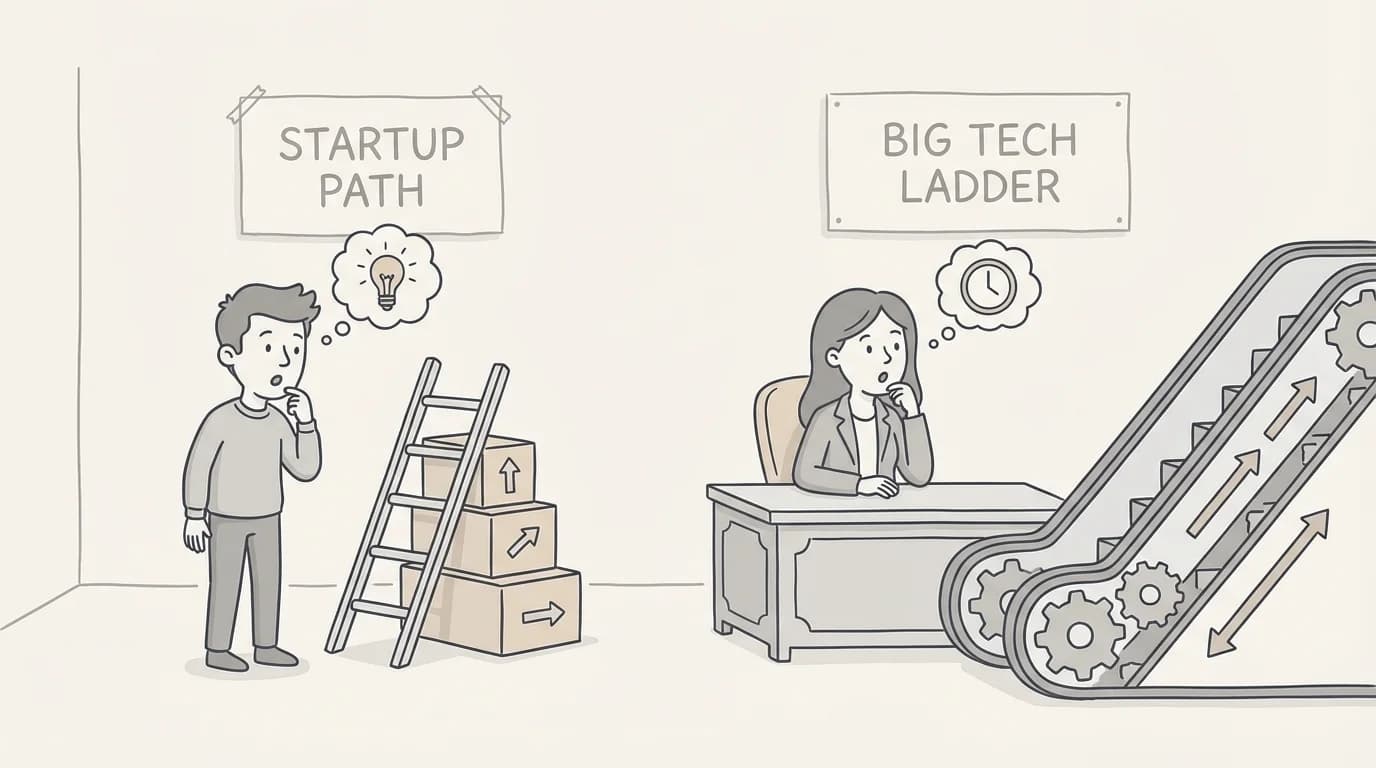
Both engineers are good at their jobs. Neither is failing. They're playing one game with the rules of another.
Two Systems That Look Nothing Alike
The core difference isn't difficulty. It's structure.
Big tech promotion is a formal system. There's a leveling framework. There are written rubrics describing what each level requires. Your manager collects evidence, writes a packet or nomination, and presents your case at a calibration meeting where a committee of managers — most of whom have never worked with you — decides whether you advance. The process runs on a fixed cycle, usually once or twice a year.
Startup promotion is informal. At most early-stage companies, there is no leveling system. There's no committee. There's often no written rubric at all. Promotion happens when the founder or your manager decides it should happen, usually because the company grew and your role grew with it. Sometimes a title change just shows up in Slack one Monday.
These aren't two variations of the same system. They reward different behaviors, run on different timelines, and define "earning it" in ways that barely overlap.
How Promotion Actually Works at Startups
At a company with fewer than 200 people, the promotion process usually looks something like this:
The company outgrows your title. You were hired as a software engineer. Eighteen months later you're running the entire data pipeline, mentoring two junior hires, and making architectural decisions that affect the whole product. At some point, someone notices that your title doesn't reflect what you're doing. That someone is usually your manager or the founder.
Someone decides, and it happens. There's a conversation — sometimes a real one, sometimes just a message. No packet. No committee. No six-month evidence-gathering period. The decision is made by one or two people who work closely enough with you to know what you've been doing.
Growth tracks company growth. If the startup is growing fast, new layers of management and responsibility keep opening up. People who are there and performing well tend to move into those roles. If the company plateaus or stalls, promotions slow down or stop regardless of your performance.
This means startup promotion is driven by three things that have nothing to do with rubrics:
- Proximity to decision-makers. The founder sees your work because you sit ten feet away. Your skip-level knows your name because there is no skip-level — they're the CEO.
- Company trajectory. A startup that doubles in headcount every year creates promotion opportunities by default. A startup that stays at 30 people doesn't.
- Relationship and trust. Without a formal process, the people who get promoted are the people leadership trusts the most. That trust is built through daily interaction, not through a written case.
How Promotion Actually Works at Big Tech
At a company like Google, Meta, Amazon, or Microsoft, the process is nearly the opposite.
There's a rubric, and it matters. Each level has documented expectations — scope, complexity, influence, leadership. Your job is to demonstrate that you're already operating at the next level, consistently, with evidence.
Your manager is your advocate, not your judge. In calibration, your manager presents your case to a room full of other managers. If they can't articulate what you did and why it mattered, your case dies in that room. The relationship still matters, but differently than at a startup. Your manager doesn't need to like you. They need ammunition to sell your work to people who've never seen it.
The cycle is fixed. Promotion decisions happen once or twice a year. Miss the window and you wait. "Almost there" means you wait too. The feedback loop between doing strong work and seeing it recognized can be six to twelve months.
Documentation is the game. Your promo packet, the written case that combines self-review, peer feedback, manager assessment, and project evidence, is the most important artifact in the process. Engineers who do exceptional work but write weak packets get passed over. Engineers who do solid work and write strong promotion cases often advance.
Why Big Tech Engineers Struggle at Startups
If you spent your career at a large company, you internalized a set of assumptions that don't transfer:
Waiting for the process to start. At big tech, you learn to plan around cycles. You time your projects to land before review season. You think in six-month increments. At a startup, there is no review season. If you sit and wait for someone to open a promotion nomination, you'll wait forever.
Expecting a rubric to guide you. Big tech engineers are trained to find the rubric, identify the gaps, and close them. At a startup, the rubric doesn't exist. What matters is whether leadership sees you as someone who can handle more — and that's a judgment call, not a checklist.
Underestimating the relationship. In big tech, your manager advocates for you in a formal process. At a startup, your relationship with the founder or CTO is the entire process. Big tech engineers who focus on "the work" and avoid relationship-building with leadership often get passed over for someone less technically skilled but more trusted.
Scoping too narrowly. Big tech rewards depth at scope. You own one system, you go deep, you demonstrate mastery. Startups reward breadth. The engineer who can do backend, debug a production incident, talk to customers, and write the post-mortem is more promotable than the one who built an elegant distributed system but won't touch the frontend.
Why Startup Engineers Struggle at Big Tech
The reverse transition is just as jarring:
Not understanding the written game. At a startup, everyone saw your work because the entire engineering team fit in one room. At a company with 10,000 engineers, nobody sees your work unless you make it visible. Your self-review, your promo packet, your design docs: these are how the committee learns you exist. Startup engineers who were never forced to write about their own impact find this deeply uncomfortable. And they're usually bad at it.
Missing the documentation habit. At a startup, you shipped the feature and moved on. Nobody asked you to write down why it mattered, what the alternatives were, or how you measured success. At big tech, that documentation is the evidence your manager uses to advocate for you. Without it, even genuinely strong work becomes invisible at calibration.
Confusing effort with impact. Startups reward hustle. Staying late, wearing multiple hats, doing whatever needs doing. All of that builds trust with leadership. Big tech doesn't care how many hours you worked. It cares about measurable impact at the appropriate scope for your level. An engineer who works 60-hour weeks on three different things but can't articulate the business impact of any of them will not get promoted.
Struggling with visibility as a skill. At a startup, visibility is automatic. The CEO was on the same Slack channel when you fixed the outage at 2am. At big tech, your manager has to fight for you in a room where nobody else knows your name. If you don't actively build visibility through design reviews, cross-team collaboration, and written updates, you stay invisible no matter how strong your output is.
The Visibility Gap Is the Biggest Difference
At a startup with 30 engineers, there is no visibility problem. Everyone knows what everyone is working on. The founder watches your pull requests. Your manager sits next to you. The surface area of the company is small enough that strong work is naturally visible.
At a company with 5,000 engineers, visibility is manufactured. Nobody stumbles across your work. A study by Judge and Bretz in the Journal of Applied Psychology found that employees who actively managed upward impressions received more promotions than equally productive peers who didn't. Not because the system is corrupt. Because in a large organization, unnarrated work is invisible work.
The startup engineer who joins big tech and keeps their head down, expecting the work to speak for itself, is making the same mistake as the big tech engineer who joins a startup and waits for someone to open a performance review portal. Both are applying the rules of one game to another.
Timing and Predictability
Big tech promotions are slower but predictable. You know the cycle. You know the timeline. You can plan around it. Most engineers at large companies move from junior to mid-level within two years, and from mid-level to senior within another two to four. Beyond senior, things slow down. Staff promotions at Google or Meta often take three to five years.
Startup promotions are faster but unpredictable. An engineer at a fast-growing startup can go from individual contributor (IC) to tech lead to engineering manager in eighteen months. Not because they leveled up on a rubric, but because the company tripled in size and someone had to lead the new team. If the company flatlines, that same engineer might sit at the same title for years with nowhere to go.
The psychological difference matters. Big tech gives you a roadmap that might frustrate you with its pace. Startups give you no roadmap at all. Whether that feels liberating or terrifying depends on how much ambiguity you can stomach.
How Compensation Interacts With Promotion Differently
At big tech, promotion is directly tied to compensation bands. Moving from L4 to L5 at Google, or E4 to E5 at Meta, means your base salary range, Restricted Stock Unit (RSU) grant, and bonus targets all shift to a higher band. Most big tech companies cap base salary around $250,000-$300,000, so real compensation growth comes from equity grants that increase with each level. The financial incentive to get promoted is baked into the system.
At startups, compensation and promotion are loosely coupled. A title change might come with a modest salary bump, or it might come with nothing but stock options in a company that may never have a liquidity event. The financial upside at a startup isn't tied to promotion — it's tied to the company's outcome. An early engineer at a startup that goes public at a $5 billion valuation makes more than a Staff engineer at Google regardless of what their title was. An early engineer at a startup that shuts down makes nothing.
This shapes behavior. At big tech, the rational move is to optimize for promotion because that's what directly increases your pay. At a startup, the rational move is to optimize for company success because your equity value depends on the exit, not your title.
Making the Switch: What to Adjust
If you're going from startup to big tech:
- Start documenting everything immediately. Write down what you built, why it mattered, and what the measurable impact was. Build this habit in your first month, not when review season approaches.
- Learn the rubric before you try to advance. Ask your manager exactly what the next level requires. Read the leveling guide. Understand what "scope" and "complexity" mean in your organization's specific language.
- Treat your manager as a stakeholder. Your manager isn't your buddy the way a startup CTO might be. They're the person who will present your case to a committee. Make their job easy by giving them clear, written evidence of your impact.
- Accept that the feedback loop is longer. You're used to shipping something and seeing the result immediately. At big tech, the gap between doing strong work and getting recognized for it can be six to twelve months. Plan for that timeline.
If you're going from big tech to a startup:
- Stop waiting for a process. Nobody is going to open a promotion portal. If you want to advance, talk to the founder or your manager directly. Say what you want.
- Go wide, not deep. The thing that made you promotable at big tech — owning one system at depth — is less valuable at a startup than being the person who can solve whatever problem is on fire today.
- Build the relationship with leadership. At a startup, trust is the promotion criteria. The founder promoting someone they deeply trust over someone with a stronger resume is not a bug in the system. It's the system.
- Recalibrate your compensation expectations. Your total comp will almost certainly drop in the short term. The bet is that your equity will be worth more if the company succeeds. Make sure you actually believe that bet before you take it.
The Real Lesson
Neither system is better. Big tech's formal process can feel bureaucratic and disconnected from actual performance. Startup informality can feel arbitrary and relationship-dependent. Both produce outcomes that frustrate deserving engineers.
The people who navigate both environments well do one thing differently: they figure out the rules of the game they're actually playing, instead of assuming the rules followed them from the last company.
The first step isn't working harder. It's asking: how does the system I'm in right now actually make promotion decisions? And then playing that game on purpose.
Whether you're navigating a big tech calibration cycle or figuring out what advancement looks like at a startup, CareerClimb helps you document wins and build the evidence that gets you promoted, wherever you work. Download the app and start building your case.