When You Are Overwhelmed at Work: A Step-by-Step Guide to Getting Back on Track

 CareerClimb
Feeling like you can't keep up?
Get coaching on what actually matters for your career right now — and what you can let go.

Share this article
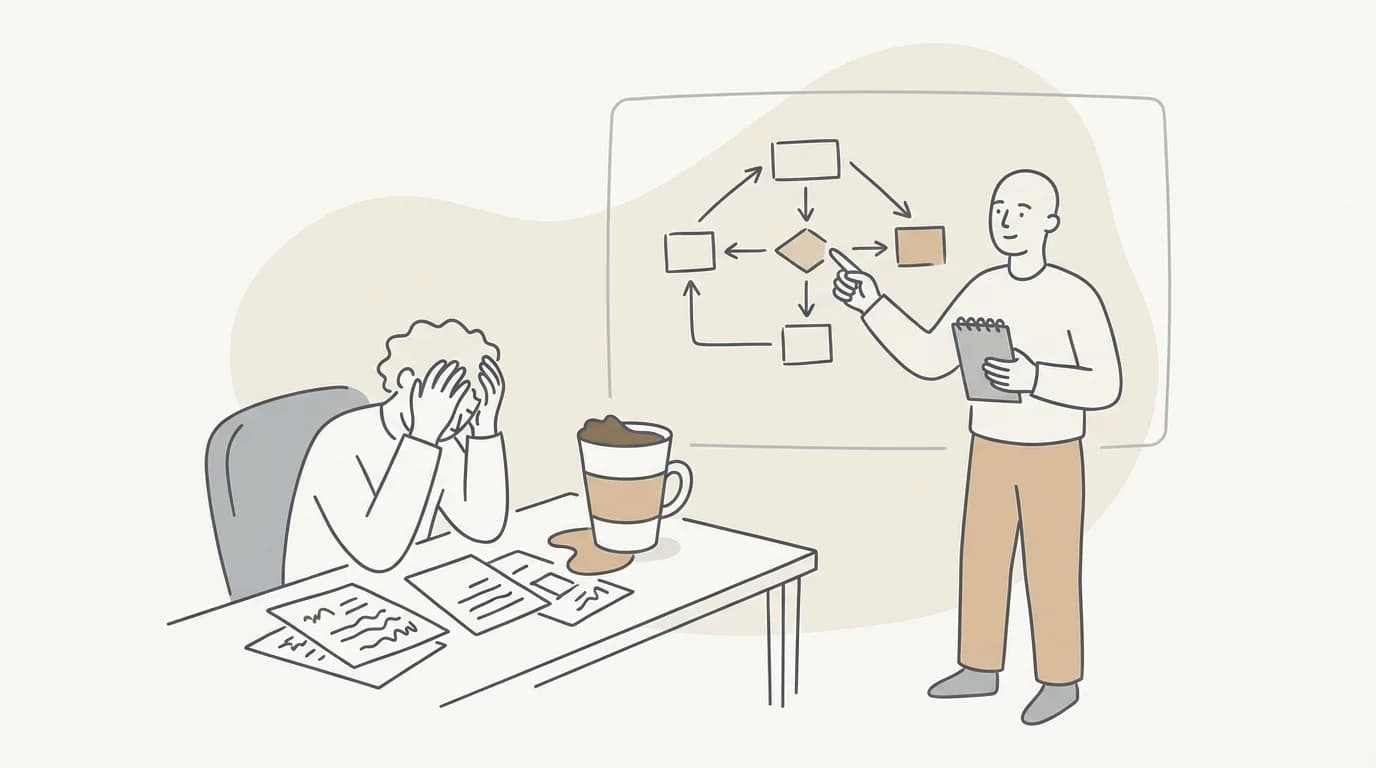
You have 47 unread Slack messages. Three pull requests waiting for review. A design doc you promised last Wednesday. A 1:1 with your manager in 20 minutes that you have not prepared for. Your team standup is in an hour, and you are not sure what you are going to say because you spent yesterday in five hours of meetings and made zero progress on your actual work.
You are not behind on one thing. You are behind on everything. And the feeling that comes with that is not stress. It is a specific, suffocating weight where your brain stops being able to prioritize at all. Everything feels equally urgent and equally impossible.
If this sounds like your week, you are not alone. A Haystack Analytics study found that 83% of software developers have experienced burnout, with high workload (47%), inefficient processes (31%), and unclear goals (29%) as the top causes. A separate survey from CIO found that 58% of IT workers feel overwhelmed by their daily responsibilities.
This is not a productivity problem you can solve with a better to-do app. This is a systemic issue, and it requires a systemic response.
Why your brain shuts down when you are overwhelmed
The overwhelm you are feeling is not laziness or poor time management. It is a well-documented cognitive response to overload.
Gloria Mark, a professor at UC Irvine who has spent decades studying attention in the workplace, found that it takes an average of 23 minutes and 15 seconds to fully regain deep focus after a single interruption. In 2004, the average person spent 2.5 minutes on a screen before switching. By her most recent measurement, that number dropped to 47 seconds.
Now think about your day. Slack notifications. Email pings. Code review requests. Meeting invites. The Microsoft Work Trend Index found that knowledge workers experience roughly 275 interruptions per day and spend 60% of their time on communication (emails, chats, meetings) rather than deep work. Only 40% is left for the actual work you were hired to do.
When your brain is hit with more inputs than it can process, the prefrontal cortex starts to shut down. Research on decision fatigue shows that the quality of your decisions degrades as the volume of decisions increases. This is why, by 3pm, you find yourself staring at a Jira ticket unable to figure out where to start. Your decision-making capacity has been drained by a hundred small choices since morning.
The WHO classified burnout as an occupational phenomenon in 2019, defining it as chronic workplace stress that has not been successfully managed. It breaks down into three parts: exhaustion, cynicism toward your job, and reduced professional effectiveness. Sound familiar?
The step-by-step system for getting back on track
Knowing why you are overwhelmed is useful. What matters more is doing something about it. Here is a concrete system you can start today.
Step 1: Do a full brain dump (30 minutes)
Open a blank document. Write down every single thing that is on your plate. Not just the tickets in your sprint. Everything. The PR reviews. The design doc. The thing you promised a coworker in passing. The oncall follow-up. The performance review prep you have been avoiding.
Get it all out of your head and onto a page. Your brain is spending energy trying to hold all of this in working memory, and that alone is draining your capacity.
Do not organize it yet. Just dump it.
Step 2: Sort into three buckets
Go through your list and label each item:
- Must happen this week. If it does not get done, something breaks, someone is blocked, or there is a real consequence.
- Matters but not this week. Important work that has a deadline further out or can be scheduled.
- Should not be on my plate. Work you took on because nobody else volunteered, or that does not actually belong to you, or that you said yes to out of reflex.
Most engineers who do this exercise find that the third bucket is larger than they expected.
Step 3: Cut or delegate before you optimize
The instinct when overwhelmed is to work faster. That is the wrong move. The right move is to shrink the pile before you start.
Look at your "should not be on my plate" bucket. For each item, ask: Can I hand this back? Can I ask my manager to reassign it? Can I say "I cannot take this on right now" to the person who asked?
You do not need to delegate dramatically. Even moving two or three items off your list changes the math. A five-minute Slack message to your manager that says "I am overloaded this sprint and need to drop X to focus on Y" is not weakness. It is the thing your manager needs to hear to help you.
Step 4: Block time for deep work before meetings fill the gaps
If your calendar is 60% meetings, you do not have a productivity problem. You have a time problem. And meetings expand to fill whatever space is available.
Before your week starts, block two to three 90-minute chunks on your calendar for deep work. Label them something specific: "Design doc for Project X" or "Code review backlog." Treat them like meetings you cannot cancel.
If someone tries to schedule over them, decline. Not rudely. Just: "I have a conflict at that time. Can we do [alternative slot]?"
This is not about being precious with your time. It is about protecting the hours where you do the work that actually matters for your career.
Step 5: Set boundaries on responsiveness
You do not need to respond to every Slack message within five minutes. The expectation of instant responsiveness is one of the biggest drivers of overwhelm in tech, and most of it is self-imposed.
Try this: check Slack at set intervals (every 60 to 90 minutes) instead of leaving it open. Mute channels that are not relevant to your current sprint. Set your status to "heads down, will respond by end of day" when you are in a deep work block.
If your team culture punishes slow responses, that is a conversation worth having with your manager. If it does not, you are probably imagining the pressure.
Step 6: End each day by writing tomorrow's top three
Before you log off, write down the three most important things you need to do tomorrow. Not the full task list. Just three. The ones that, if you finished them and nothing else, you would call the day a win.
This does two things. First, it gives your brain permission to stop processing work for the evening. Second, it means you start tomorrow with a plan instead of opening Slack and letting the chaos dictate your priorities.
The conversation you probably need to have
If you have been overwhelmed for more than two or three weeks, the steps above will help, but they will not solve the root cause. The root cause is usually one of two things: you are carrying too much work for one person, or you are spending your time on the wrong work.
Either way, the fix involves a conversation with your manager. Not a vague "I am stressed" conversation. A specific one.
Bring your brain dump list. Show them the three buckets. Say: "Here is everything on my plate. I am trying to focus on [these priorities] but I keep getting pulled into [these other things]. Can you help me figure out what to deprioritize?"
This is not complaining. This is managing up. Managers cannot help you if they do not know what you are carrying. And most managers would rather hear about a capacity problem before it becomes a missed deadline. If you need specific scripts for that conversation, the guide to telling your boss you are overwhelmed has five word-for-word options.
Overwhelm and your career
Here is the part nobody talks about: being chronically overwhelmed is bad for your promotion case. When you are drowning, you default to reactive work. You stop volunteering for high-impact projects. You stop documenting your wins. You stop thinking strategically about your career because you are just trying to survive the week.
The irony is that many engineers get overwhelmed precisely because they care about doing well. They say yes to everything because they want to be seen as reliable. But saying yes to everything means you never have the bandwidth to do the kind of work that actually gets noticed in promotion discussions.
Getting your workload under control is not just about feeling better. It is about making space for the work that advances your career. If the overwhelm has tipped into persistent frustration you cannot shake, diagnosing why you are frustrated at work helps you separate workload problems from deeper mismatches.